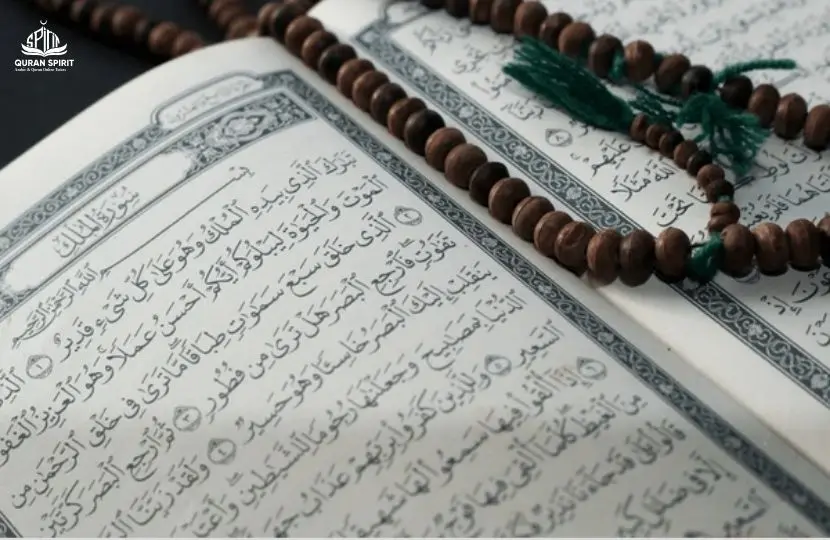
Today’s session covered Surah Al-Mulk’s virtues, Makkan context, rhetorical power, three-part structure, Ar-Rahman’s mercy amid divine kingship, and practical takeaways like nightly recitation for grave protection. What follows is an abridged transcript of the full session.
Download original transcript here.
Position in the Quran
Surah Al-Mulk stands as the 67th chapter of the Quran. The Arabic word Surah means “chapter,” while its 30 verses are called ayah (plural: ayat). The Quran divides into 30 equal portions known as Juz’, and Surah Al-Mulk opens the 29th Juz’. This Juz’ contains short, intense chapters that emphasize the Hereafter and God’s majesty, and Al-Mulk’s placement at its beginning immediately establishes a tone of authority, argument, and awe. The Surah presents a complete, self-contained case about who truly owns the universe, the purpose of human existence, and what awaits us after death.
Names and Virtues
Arabic words carry multiple layers of meaning, so Surah Al-Mulk bears several traditional names. It is called Al-Mulk (“The Dominion” or “Kingdom”) from its opening verse: “Blessed is He in whose hand is the dominion.” It is also known as Tabarak from the first word “Tabaraka” meaning “Blessed is He.” Scholars call it Al-Mani’ah (“The Preventer/Protector”) because of its protection from grave punishment, and Al-Munjiyah (“The Rescuer/Deliverer”) because it intercedes for its reciter until forgiveness.
The Prophet Muhammad (peace be upon him) highlighted its virtues through authentic Hadith. He described the 30-verse chapter beginning “Tabaarak alladhi bi yadihi l-mulk” as “the defender, the deliverer—it delivers from the punishment of the grave” (Jami’ at-Tirmidhi 2890). His Companion Abdullah ibn Mas’ud (ra) said: “Whoever recites it every night, Allah will protect him from the torment of the grave. We used to call it al-Mani’ah (the Preventer) during the Prophet’s time.” Another narration confirms it intercedes until the reciter receives forgiveness.
Revelation Context
Surah Al-Mulk is a Makkan Surah, revealed in Makkah before the Prophet’s migration to Madinah, ranking approximately 76th-77th in the order of revelation. During this period, Muslims faced intense persecution from the powerful Quraysh tribe. Makkan Surahs therefore focused on building faith foundations—what scholars call ‘aqidah or creed—emphasizing God’s absolute Oneness (Tawhid), signs of creation, the reality of the Hereafter, and powerful rhythmic language that penetrated hearts and minds.
No single authenticated incident prompted its revelation. Rather, it addressed Makkah’s pervasive atmosphere of rejection. The Quraysh denied resurrection, claiming it was impossible for scattered dust and bones to be brought back to life. The Surah responds decisively: the One who created you initially certainly possesses the power to resurrect you. At its heart lies verse 67:2: “[God] created death and life to test you [as to] which of you is best in deed.”
Rhetorical Power
Surah Al-Mulk possesses a distinct personality—like a cosmic interrogator or divine attorney conducting a cross-examination. Rather than merely stating truths, it poses unanswerable rhetorical questions that compel the listener to acknowledge reality:
- “Do you see any flaw?” (after describing perfectly layered heavens in verse 3)
- “Who is this that can be an army for you to help you other than the Most Merciful?” (verse 20)
- “Who is it that provides for you if He withholds His provision?” (verse 21)
- “Is he who walks fallen on his face [more] guided than he who walks erect on a straight path?” (verse 22)
This interactive style places the listener on the witness stand. The majestic, bracing tone—not soft or sentimental—awakens both intellect and spirit.
Linguistic Beauty
As the literal word of God in Arabic, the Quran’s linguistic miracle shines through Surah Al-Mulk. Its verses maintain moderate length for maximum impact, creating steady rhythm through rhyme patterns like “-īr, -ūr, -ār, -āb.” Words such as Qadīr (All-Powerful), Ghafūr (All-Forgiving), Basīr (All-Seeing), and Nushūr (Resurrection) form a memorable cadence.
The sounds themselves reflect meaning: harsh, heavy consonants evoke Hell’s raging inhale and boiling fury, while softer sounds mimic the exhausted sigh of the humbled gaze returning from the flawless heavens. The constant rhetorical questions create percussive rhythm, like measured blows awakening the conscience. A skilled Qari (Quran reciter) brings this beauty alive—listen and let the opening verse fill you with awe, the closing with humility and gratitude.
Three-Part Structure
The Surah unfolds in three masterful movements, like a perfectly constructed sermon:
Movement I (verses 1-5): Divine Majesty declaration. Verse 1 establishes God’s absolute dominion: “Blessed is He in whose hand is the dominion, and He is over all things competent.” Verse 2 reveals creation’s purpose: testing who excels in deeds. Verses 3-5 present Exhibit A—the flawlessly layered seven heavens, challenging: “Look again… then look again… you will return your gaze humbled while it is fatigued.”
Movement II (verses 6-22): Consequences and proofs. Verses 6-11 vividly depict Hell’s keepers questioning its inhabitants who admit rejecting messengers. Verse 12 promises believers forgiveness and great reward for fearing God “in the unseen.” Verses 13-22 marshal earthly proofs: God’s knowledge of hidden and open speech, the stable earth upholding birds by Ar-Rahman’s power, human senses as gifts often met with ingratitude.
Movement III (verses 23-30): Final challenge. All creation returns to God inevitably. The cosmic argument lands personally: “Say, ‘Have you considered: if your water was to become sunken, then who could bring you flowing water?'”
Core Themes
The Surah weaves interconnected themes:
- Absolute dominion: God owns and controls everything without limitation
- Life’s purpose: A test measuring quality of deeds, not quantity
- Creation’s perfection: Layered heavens as primary proof of divine wisdom
- Unseen faith rewarded: Those fearing God privately receive forgiveness
- Divine omniscience: God knows what we conceal and proclaim
- Earthly proofs: Stable earth, flying birds, flowing water as signs
Ar-Rahman’s Golden Thread
Though centered on kingship and dominion, a golden thread runs throughout: God’s name Ar-Rahman (The Most Merciful). The birds remain aloft not by physics alone, but by Ar-Rahman’s sustaining mercy. When disbelievers cannot name any power besides Ar-Rahman to protect or provide for them, the argument becomes unassailable. This reveals a profound truth: the universe operates not by cold, impersonal force, but by a King whose dominion manifests constant mercy sustaining every moment of existence.
Practical Lessons
Surah Al-Mulk translates directly into daily spiritual practice:
- Live purposefully: Every action becomes part of an exam watched by the King
- Contemplate creation: Follow the command “Look again”—observe signs in nature and life
- Cultivate humility: From majestic heavens to basic water, everything reveals human dependence
- Build unseen integrity: True character emerges when only God witnesses
- Practice active gratitude: Transform entitlement into recognition of constant mercy
Daily Integration
Make Surah Al-Mulk a practical spiritual companion:
- Nightly recitation: Following Hadith guidance, recite before sleep for grave protection
- Gradual memorization: Learn two ayahs daily (complete in 15 days), review in prayers
- Reflective practice: Connect each verse to daily observations—sky, earth, water
- Moment of anxiety: Recite and remember: dominion belongs to Ar-Rahman
Closing Invitation
Surah Al-Mulk transcends mere text—it conducts a conversation about true power, human purpose, life after death, and where divine mercy meets majestic authority. Join our upcoming Ramadan series learning two ayahs every three days with thematic tafseer. Let these 30 verses reshape how you see the sky above, earth beneath, and water in your glass—anchoring your heart in the care of the Merciful King whose dominion encompasses all.
References
- https://quran.com/surah/67/info
- https://en.wikishia.net/view/Sura_al-Mulk
- https://myislam.org/surah-al-mulk/
- https://myislam.org/virtues-of-surah-mulk/
- https://madinahquranacademy.com/reward-of-reciting-surat-ul-mulk-is-not-same-as-just-listening-to-it/
- https://sunnah.com/tirmidhi:2890
- https://www.missionislam.com/quran/revealationorder.htm
- https://quran.com/en/67:2/tafsirs/en-tafsir-maarif-ul-quran
- https://surahalmulk.net/death-and-life-in-surah-mulk/
- https://www.thelastdialogue.org/surah-resources/surah-mulk-main-characters/